

Blog
5 Types of Laboratory Equipment for Chemistry Explained

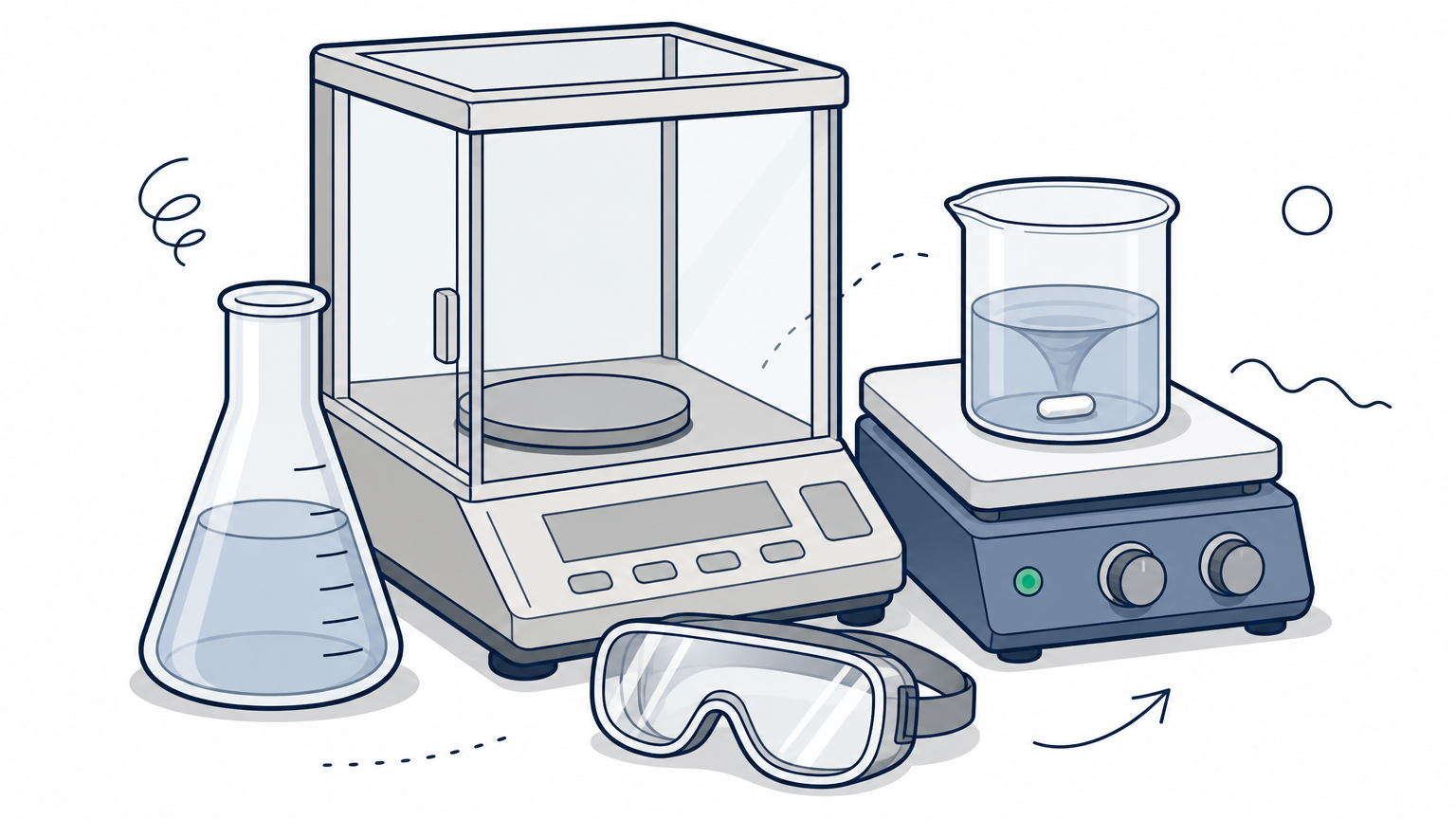
The core laboratory equipment for chemistry falls into five groups: glassware, balances and meters, heating and stirring tools, supports and separation gear, and safety equipment. A good pick matches the accuracy your work needs, resists the chemicals you use, and cleans easily. Students and teachers need glassware, a balance and a hotplate first. Analytical and quality-control technicians need analytical balances, meters and calibrated volumetric glassware. Lab managers setting up a new room need all five groups.
Most lists simply name 40 items in a row. You end up knowing a beaker from a flask but not why you cannot measure with one, or which tool belongs at which step of a procedure. That is the gap this article closes.
Below, chemistry laboratory equipment is grouped by job. For each group you get what the items do, how to use them correctly and what to check before you buy. Masiye Labs has supplied laboratory equipment and chemicals in South Africa since 2013, so the buying notes are written for local buyers who compare prices in Rand.
1. Laboratory glassware
Glassware holds, mixes and measures your liquids. The key split is between vessels that only hold liquid and vessels that measure it accurately.
Key items and what they do
| Item | Main use | Accuracy |
|---|---|---|
| Beaker | Holding, mixing, pouring | Rough, about 5% |
| Erlenmeyer flask | Swirling, reactions, titrations | Rough, about 5% |
| Test tube | Small samples, qualitative tests | None |
| Graduated cylinder | Measuring different volumes | Moderate, about 0.1 mL with practice |
| Volumetric flask | One exact volume, dilutions | High |
| Volumetric pipet | Transferring one exact volume | High |
| Buret | Titrations, dispensing | About 0.01 mL with practice |
Beakers and Erlenmeyer flasks are not measuring tools, even when they carry printed markings. The markings are rough estimates. Use them to hold, heat and swirl, and use a cylinder, pipet or volumetric flask when the number matters.
Hold liquid in a beaker, but measure it in a volumetric flask, pipet or buret.
How to use it well
Read every liquid level at eye height, at the bottom of the meniscus. In a volumetric flask, stop exactly at the etched line, then hold the stopper and invert the flask several times to mix.
Check whether a pipet is marked TD or TC. To deliver (TD) glassware gives the stated volume once the liquid drains out under gravity. To contain (TC) glassware needs a starting and a final reading, and you subtract one from the other.
What to look for when buying
- Borosilicate glass, which tolerates heat and most reagents.
- Class A calibration for volumetric flasks, pipets and burets.
- Permanent, clearly etched or fired graduations.
- Spare stoppers sized to your flasks.
Glassware is the cheapest group to stock. Glass beakers start from about R36 in the Masiye Labs Laboratory Glassware collection.
2. Balances and measuring instruments
Balances give you mass, and meters give you pH, conductivity or absorbance. Together they turn a procedure into numbers you can record and repeat.
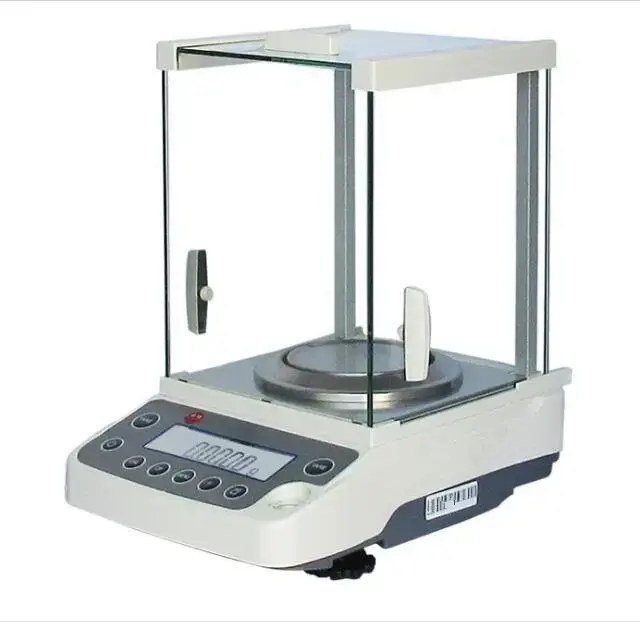
Key items and what they do
| Item | What it measures | Typical readability |
|---|---|---|
| Analytical balance | Small masses for accurate work | 0.0001 g |
| Precision balance | General weighing, larger samples | 0.001 g to 0.01 g |
| Weighing scale | Bulk quantities | Coarse |
| pH meter | Acidity or alkalinity of a solution | Set by the electrode |
| Spectrophotometer or colorimeter | Light absorbed by a liquid sample | Set by the instrument |
| Conductivity meter | Electrical conductivity of a solution | Set by the probe |
Readability should match the job. Say you weigh 0.5 g of a reagent for a standard solution. A balance reading to 0.0001 g carries about 0.02% relative uncertainty. One reading to 0.01 g carries about 2%, a hundred times worse.
Buy the readability your method demands, because a cheaper balance cannot be corrected later.
How to use it well
Always weigh in a container such as a weigh boat, weigh paper or glassware. Place it on the pan, close the cover or draft shield, let the reading settle and press tare once. Do not hold the tare button down, because some balances then change units.
Brush spills off the pan immediately, since chemicals corrode it. Never return surplus chemical to the reagent bottle. Weigh objects at room temperature, because a warm object causes drifting readings.
What to look for when buying
Check capacity against readability, because the two trade off. Ask whether a draft shield is included and how calibration is done, using internal or external weights. Put the balance on a vibration-free bench. The Balances And Scales collection at Masiye Labs covers analytical balances, precision balances and weighing scales.
3. Heating and stirring equipment
Heating tools drive reactions, dissolve solids and keep samples at temperature. Stirring tools keep the mixture uniform while you do it.
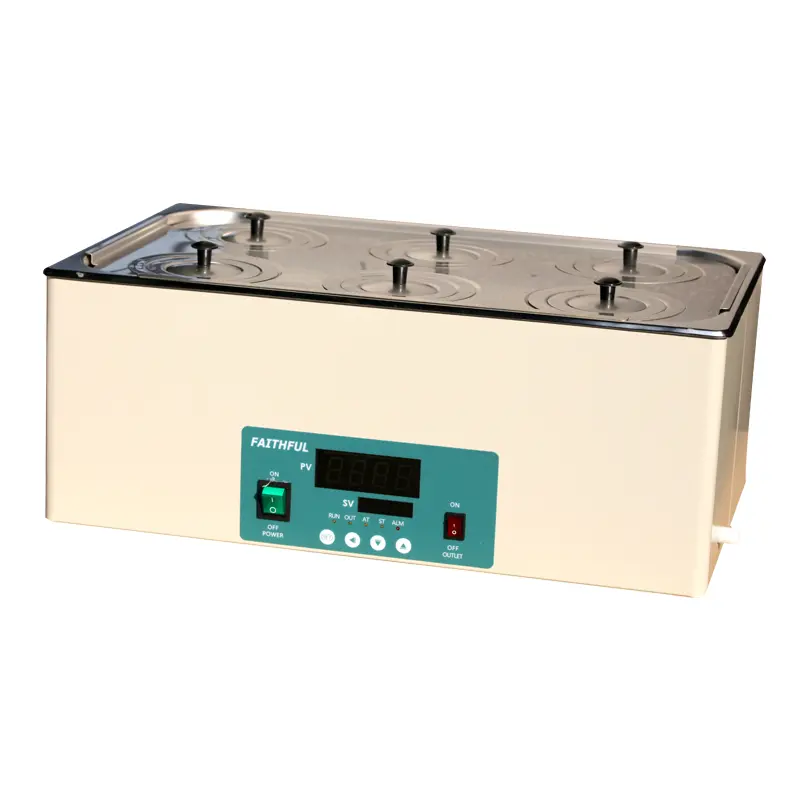
Key items and what they do
| Item | Main use |
|---|---|
| Bunsen burner | Open-flame heating, quick and hot |
| Hot plate | Flameless heating of flasks and beakers |
| Hotplate magnetic stirrer | Heating and stirring together |
| Water bath | Steady, gentle temperature over a long time |
| Tripod and wire gauze | Support a beaker over a flame and spread the heat |
| Crucible and tongs | Heating solids to very high temperatures |
A hot plate is the better choice when an open flame is undesirable, for example near flammable solvents. A water bath suits incubations and slow warming. A Bunsen burner suits fast heating of non-flammable samples.
Use a flame only when nothing flammable is nearby, and otherwise heat on a hot plate or in a water bath.
How to use it well
On a Bunsen burner, open the air vents until you see a blue inner cone with no yellow tip. A yellow, sooty flame has too little air. The hottest point sits at the top of the inner blue cone.
With a magnetic stirrer, pick a stir bar that fits the vessel. Set the speed so the bar spins in the middle and does not keep hitting the glass. Move hot crucibles only with tongs.
What to look for when buying
- A hot plate top that resists chemical spills and is easy to wipe.
- Digital temperature control and a stated maximum temperature.
- For water baths, the working volume and temperature range.
- For crucibles, the material that suits your temperature and sample.
Masiye Labs lists Hotplate Magnetic Stirrers, Water Baths and Laboratory Crucibles as separate collections, so you can compare models side by side.
4. Supports, filtration and handling tools
These tools hold glassware in place, move materials safely and separate solids from liquids. They cost little but decide whether a setup is stable and clean.
Key items and what they do
| Item | Main use |
|---|---|
| Ring stand with rings | Holds clamps and glassware that cannot stand alone |
| Buret clamp and utility clamp | Fix burets and flasks at the right height |
| Test tube rack and holder | Store tubes, or hold a hot tube safely |
| Spatula | Transfers powders and solids |
| Funnel and filter paper | Pours liquids or filters out solids |
| Buchner funnel and filtering flask | Vacuum filtration to keep the solid |
| Separatory funnel | Separates two liquids that do not mix |
| Wash bottle | Dispenses distilled water for rinsing |
| Desiccator | Keeps moisture-sensitive material dry |
| Centrifuge | Spins solids out of liquid in test tubes |
Filtration is where the choice matters most. Gravity filtration with a funnel is fine for routine work. Vacuum filtration through a Buchner funnel is faster and standard when you want to retain a crystalline solid.
Match the filtration method to what you want to keep, the filtrate or the solid.
How to use it well
Use a clean spatula for each reagent and never put anything back in a reagent bottle. Squeeze a pipet bulb gently, so liquid never travels up into the bulb and contaminates it.
Load a centrifuge with an even, balanced number of tubes. A thumping sound means the load is unbalanced, so stop it and reload.
What to look for when buying
Choose clamps with rubber or coated jaws, which grip glass without scratching it. Match the filter paper grade to your particle size. Pair a Buchner funnel with a vacuum pump rated for the vapors you will pull through it. Masiye Labs stocks filter papers, filtration equipment and vacuum filtration pumps for these setups.
5. Safety equipment
Safety equipment protects your eyes, skin and lungs from spills, fumes and flames. It is the one group you never skip, whatever your budget.
Key items and what they do
| Item | Main use |
|---|---|
| Safety goggles | Protect eyes from splashes and fumes |
| Gloves | Protect skin, with material matched to the chemical |
| Lab coat | Protects skin and clothing from spills |
| Fume hood | Draws noxious or harmful gases away from you |
| Chemical storage cabinet | Keeps reagents separated and secured |
Goggles must be worn at all times in the lab, not only during a hazardous step. Work in a fume hood whenever a procedure releases volatile or harmful vapors.
Put your goggles on before you open anything, because most accidents happen in the first minute.
How to use it well
Gloves protect only against the chemicals they resist, so check the manufacturer’s chemical compatibility chart before you rely on them. Store incompatible reagents, such as acids and bases or flammables and oxidizers, in separate cabinets.
What to look for when buying
- Goggles rated for splash protection that fit over prescription glasses if needed.
- Gloves in the right size and material for your reagents.
- For fume hoods, documented airflow testing and a proper installation plan.
- Storage cabinets suited to the class of chemical you keep.
Safety wear, fume hoods and chemical storage cabinets all appear in the Masiye Labs catalogue.
Building your chemistry lab kit
Chemistry laboratory equipment comes down to five jobs: holding and measuring, weighing, heating, handling and separating, and staying safe. Start with the glassware, balance and safety gear your procedures require. Then add heating, filtration and meters as your work grows. Always match accuracy to the method, and never use a beaker where a volumetric flask belongs.
When you are ready to buy, shop the laboratory equipment range online, or add products to a quotation first if you need approval before you order.