

Blog
Cocamidopropyl Betaine for Hair: Benefits and Side Effects

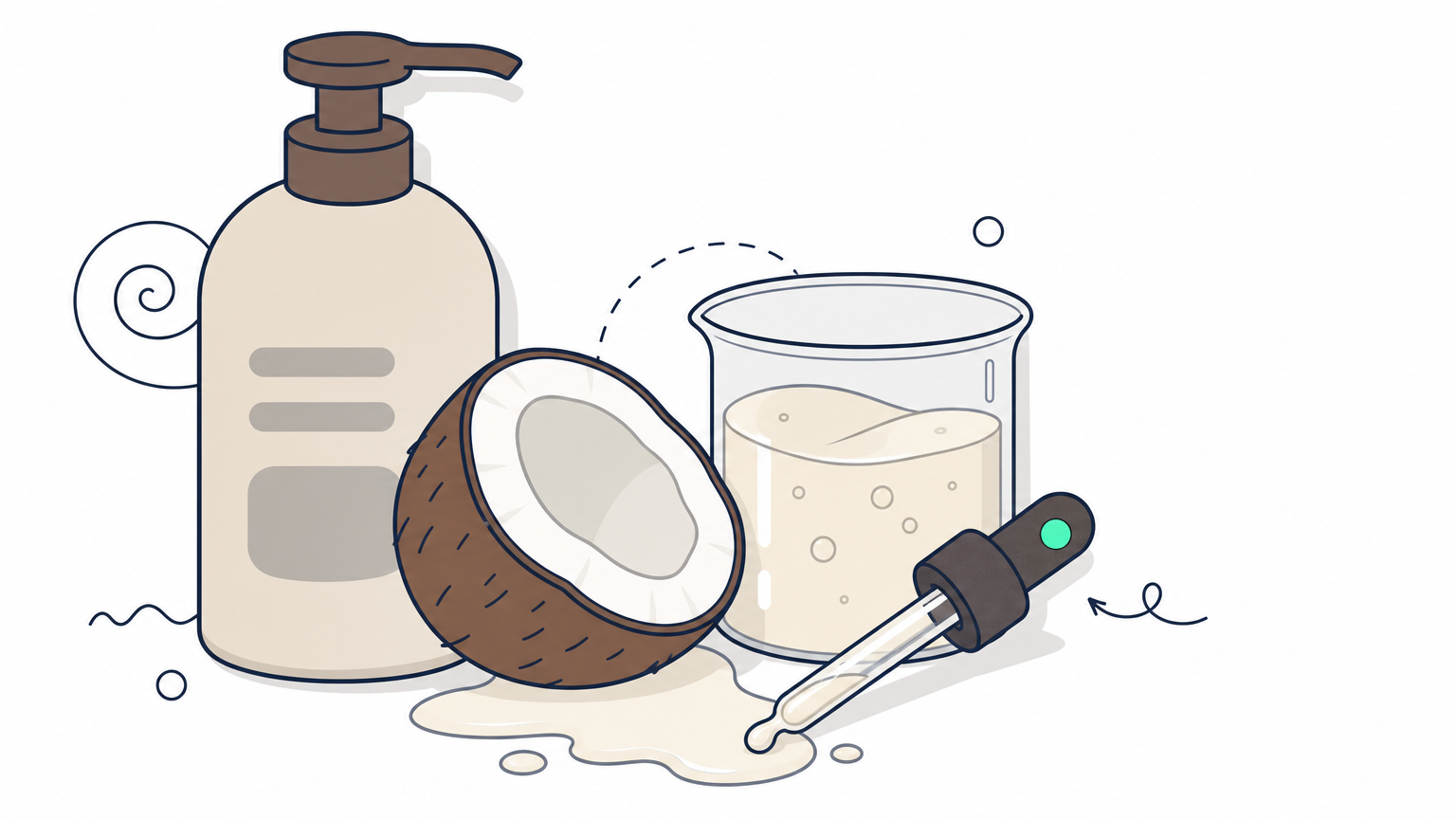
Cocamidopropyl betaine for hair is a mild, coconut-derived surfactant that boosts foam, thickens shampoo and softens the harshness of stronger cleansers. For most people it is safe in shampoo, because it is used at low levels and rinsed off. A small share of users react to it, usually with scalp itching, redness or flaking, and the trigger is often manufacturing residue in the raw material rather than the molecule itself.
This article explains what the ingredient does inside a shampoo, what the safety data says, which side effects to watch for, and how to test a product on your own scalp. It also compares the ingredient with sulfates and other surfactants, and clears up the confusion with plain betaine. The last section is for anyone who makes hair products and needs to buy and handle the raw material.
Masiye Labs supplies raw detergent and cosmetic grade chemicals to formulators, manufacturers and small producers across South Africa, including cocamidopropyl betaine (CAPB) at 30% active. That puts us close to the ingredient at the raw material stage, and the article draws on that as well as on the published safety research.
Why cocamidopropyl betaine is in your shampoo
Cocamidopropyl betaine is in your shampoo because it makes the cleansing system foam better, feel thicker and rinse milder. On its own it is a modest cleanser. Its value lies in what it does for the stronger surfactants around it.
What it does in a shampoo
Formulators add it for four jobs. The table shows each job and what you notice in the shower.
| Job in the formula | What it does | What you notice |
|---|---|---|
| Foam booster | Stabilizes the lather made by other surfactants | Richer, longer-lasting foam |
| Mildness | Reduces the irritation potential of harsher cleansers | Less tightness and stinging |
| Viscosity builder | Thickens the shampoo when paired with anionic surfactants | A shampoo that pours slowly, not like water |
| Antistatic agent | Reduces static electricity in hair | Fewer flyaways, easier combing |
Of the four, mildness matters most for your scalp. A shampoo built only on a strong cleanser can feel squeaky and tight. Adding CAPB lowers the overall irritation of the blend while keeping the lather people expect.
What the ingredient actually is
CAPB is made by reacting coconut fatty acids with dimethylaminopropylamine (DMAPA), then converting the intermediate with a chloroacetate salt. The finished molecule is amphoteric, meaning it carries both a positive and a negative charge. That is why it blends with almost every other surfactant in a formula.
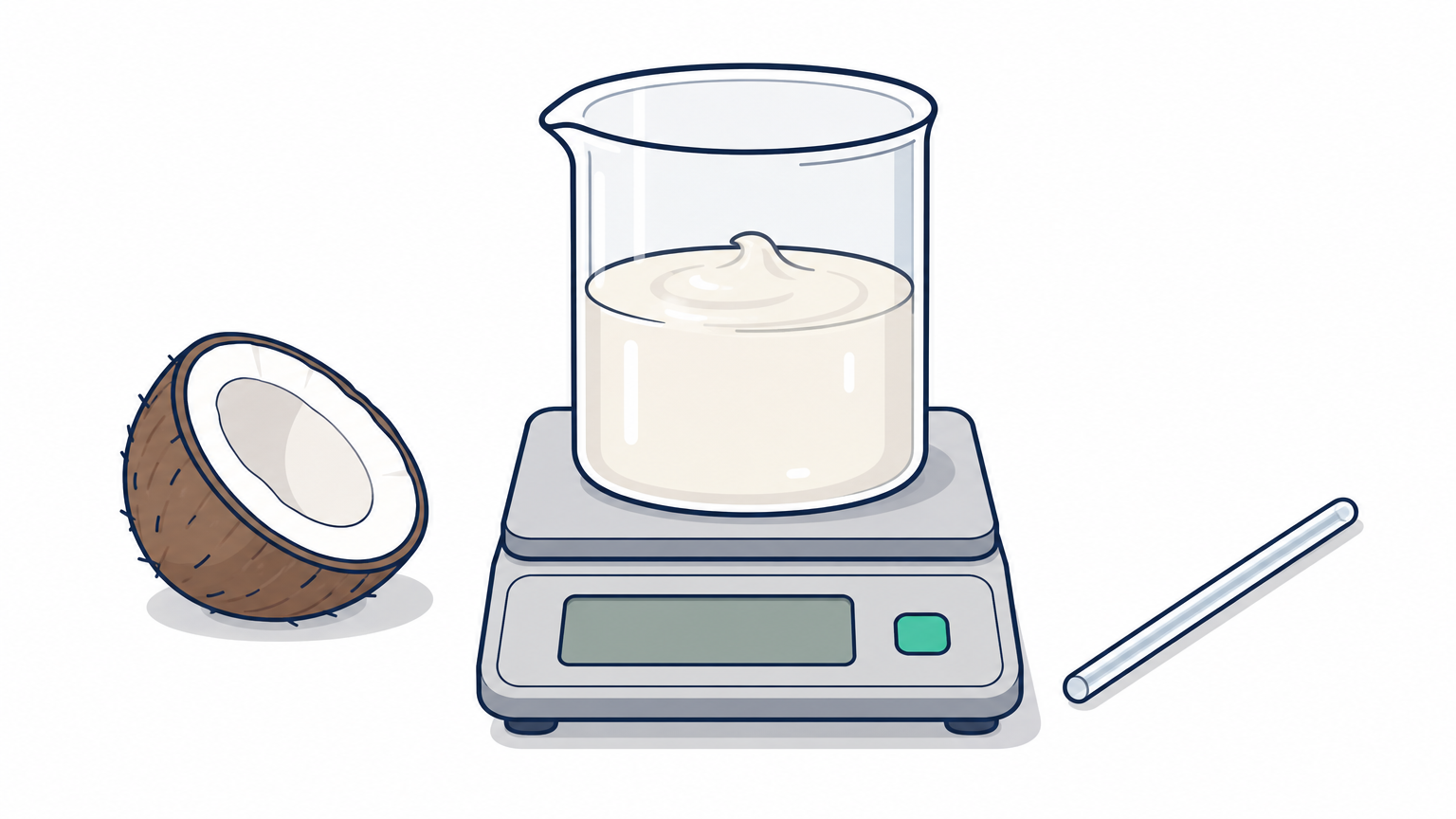
The raw material is a pale yellow liquid that dissolves easily in water. Its chemical formula is C19H38N2O3 and its CAS number is 61789-40-0. It is usually sold as a 30% active solution and then diluted into the finished shampoo. On a label you will see it as "cocamidopropyl betaine" or the older synonym "cocamidopropyl dimethyl glycine".
Cocamidopropyl betaine rarely cleans alone. It makes the surfactants around it milder, foamier and thicker.
Is cocamidopropyl betaine safe for hair and scalp?
Yes, for most people it is safe at the levels used in shampoo. A 2024 safety assessment of cocamidopropyl betaine concluded that its use in cosmetics is safe under current usage conditions. It did note mild skin irritation, eye irritation and a potential for skin sensitization.
What the safety assessment found
The reviewers calculated a margin of safety above 100 when CAPB is used at up to 6% in leave-on products and up to 30% in rinse-off products. A margin of 100 or more is the usual threshold for acceptable risk. The figures below come from the same review.
| Measure | Finding |
|---|---|
| Margin of safety | Above 100 at 6% (leave-on) and 30% (rinse-off) |
| Repeated oral dose in rats (92 days) | No observed effect level of 250 mg/kg/day |
| Acute oral toxicity (30% active, rats) | LD50 about 4.9 g/kg in several studies |
| Use in 2010 (industry data to the US FDA) | 2,743 cosmetic products, at 0.005% to 11% |
The review found that the doses behind these figures are far above anything a shampoo user is exposed to. Real exposure through cosmetics was estimated at roughly 0.001 to 0.93 mg/kg/day.
Why concentration and rinsing matter
Strength changes the picture. Full-strength 30% CAPB was a mild skin irritant in rabbits, while a 50% dilution of it was not irritating. In rabbit eyes, 30% unrinsed was corrosive, but the same dose rinsed caused only minimal irritation. A 10% solution irritated unrinsed eyes and did not irritate rinsed ones.
The practical lesson is simple. Finished shampoos contain a small fraction of that 30%, and shampoo is designed to be rinsed. If shampoo gets in your eyes, rinse with plenty of water. Leave-on products such as conditioners and styling creams call for more caution, which is why the assessment sets the lower 6% ceiling for them.
Does it damage the hair itself?
The safety data is about skin and eyes, not hair structure, and none of it reports hair damage or hair loss. CAPB is a mild surfactant and dissolves readily in water, so it rinses out. If your hair feels worse after switching shampoos, look first at the whole formula, including the stronger cleansers and any fragrance, and at whether your scalp is inflamed.
At shampoo concentrations and with proper rinsing, the evidence supports cocamidopropyl betaine as safe for most hair and scalps.
Cocamidopropyl betaine side effects to watch for
The side effects are scalp and skin irritation and, in a minority of people, allergic contact dermatitis. Typical signs are itching, redness, flaking or eczema on the scalp, and sometimes on the forehead, ears, neck, face or eyelids where shampoo runs down. Stinging eyes are common with any shampoo and usually pass once you rinse.
Irritation versus allergy
These two reactions look similar but behave differently, and telling them apart decides what you do next.
| Irritant reaction | Allergic reaction | |
|---|---|---|
| Cause | Concentration, contact time, harsh formula | Immune sensitization to a specific substance |
| Who gets it | Anyone, more likely with dry or damaged skin | Only people who have become sensitized |
| Timing | Soon after use | Often a day or two after exposure |
| Pattern | Fades when you change or dilute the product | Returns every time you meet the substance |
Many "reactions to CAPB" turn out to be irritation from the formula as a whole. One controlled study of patients with a diagnosed CAPB allergy found that several doubtful patch-test results were more likely irritant than allergic.
Where allergic reactions come from
Researchers suspect that impurities in the raw material, not the finished molecule, cause most true allergies. The two usual suspects are amidoamine and DMAPA, both leftovers from the manufacturing route. People who test positive to either are advised to avoid CAPB products. A large patch-test series also suggested that higher-purity CAPB is linked to fewer sensitizations.
The patch-test numbers need careful reading, because the patients were already suspected of having dermatitis. They do not describe the general population.
- 29 of 10,798 patients (0.27%) reacted in one large series.
- 56 of 781 patients (7.2%) reacted in a group suspected of occupational dermatitis that included 217 hairdressers. Eight of the definite cases were hairdressers with hand dermatitis.
- 12 of 210 patients (about 5.7%) reacted in a group suspected of cosmetic dermatitis.
Allergy to CAPB is real, but uncommon among people who simply use shampoo. Hairdressers, who handle it daily, carry the higher risk.
What to do if you react
Stop the product and rinse the area well. Then check every product that touches the same skin, because CAPB also appears in body washes, face cleansers, liquid hand soaps and some toothpastes. If the rash clears within days of stopping and returns when you restart, you have your answer.
See a doctor if the reaction is severe, spreading, swollen or does not clear. A dermatologist can run a patch test, and you can ask that it covers CAPB along with amidoamine and DMAPA.
Most scalp reactions are irritation from the whole formula. A true allergy to cocamidopropyl betaine is uncommon, but it repeats every time you use the product.
How to check and test a shampoo that contains it
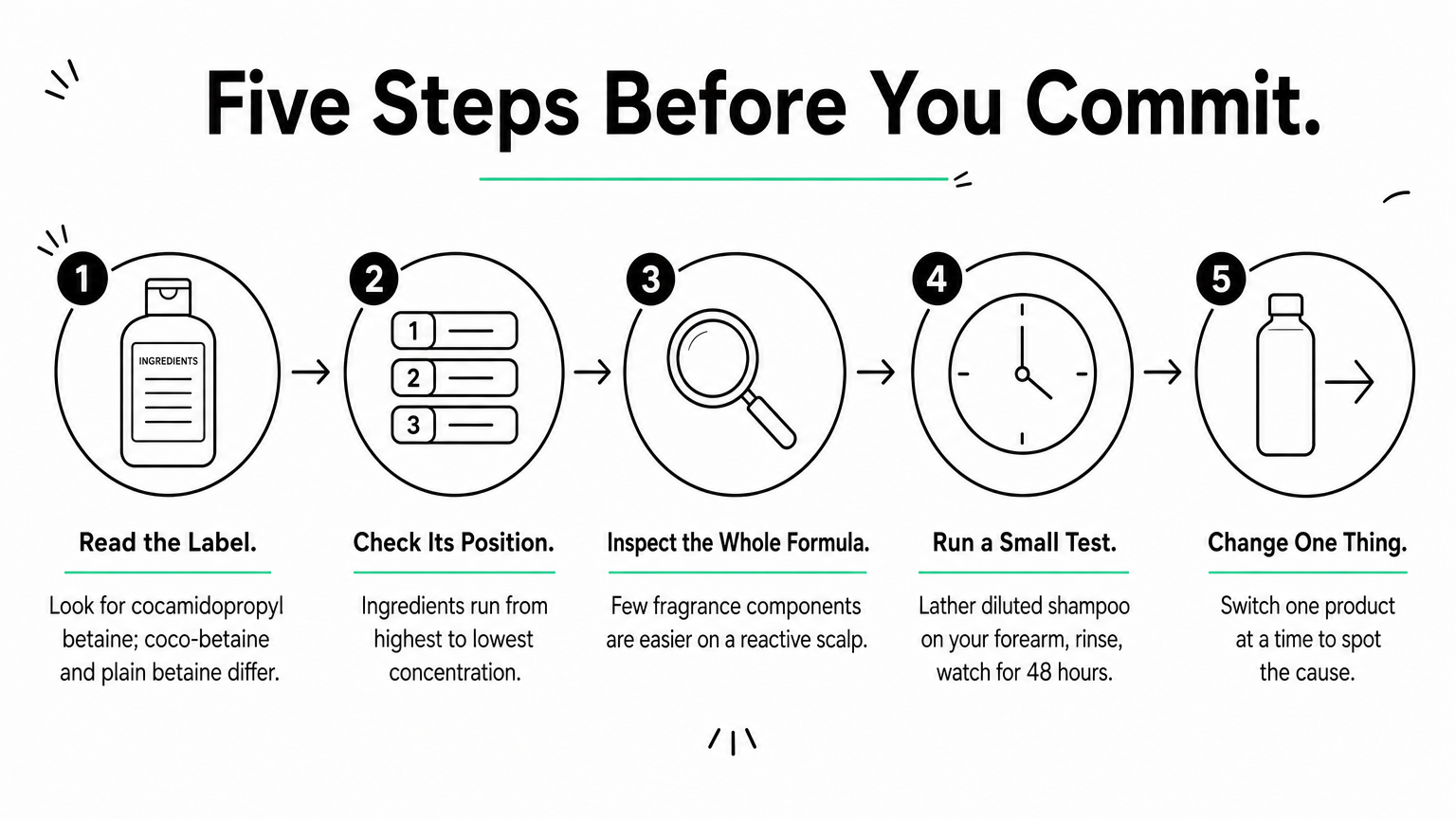
Check the ingredient list, introduce one new product at a time, and test it on a small patch of skin before you commit. The steps below take about five minutes of effort and save weeks of guesswork.
A five-step check before you commit
- Read the ingredient list. Look for "cocamidopropyl betaine". Note that "coco-betaine" and plain "betaine" are different ingredients.
- Check its position. Ingredients are listed from highest to lowest concentration, down to about 1%. CAPB near the top means a larger share of the surfactant system.
- Look at what surrounds it. A mild surfactant mix with few fragrance components is easier on a reactive scalp than one with a long list of perfumes and preservatives.
- Run a small test. Lather a little diluted shampoo on your inner forearm, rinse, and watch the spot for 48 hours. This catches irritation, but it is not a substitute for a dermatologist’s patch test if you suspect an allergy.
- Change one thing at a time. If you switch shampoo, conditioner and styling products together, you cannot tell which one caused a problem.
Matching it to your hair and scalp
The ingredient is a good fit in many situations, but the formula matters more than any single ingredient. Use this as a starting guide.
| Your situation | What to look for |
|---|---|
| Oily scalp | A blend where CAPB supports a stronger cleanser, rather than CAPB alone |
| Dry, curly or frizzy hair | Mild surfactant systems, which cleanse with less stripping |
| Colored or chemically treated hair | A gentler cleansing system, which suits fragile hair, though no single ingredient protects color |
| Sensitive or reactive scalp | Short ingredient lists and thorough rinsing, plus a patch test first |
| Babies and children | Products made for them, since CAPB is common in baby formulas but the whole formula counts |
Read the label, test a small area for two days, and change one product at a time. That routine finds a problem ingredient faster than guessing.
How cocamidopropyl betaine compares with sulfates and other surfactants
Cocamidopropyl betaine is not a sulfate, and it is not a replacement for one in every role. It is an amphoteric co-surfactant that supports and softens other cleansers, so most shampoos, sulfate-free ones included, use it in a blend.
CAPB next to other common shampoo surfactants
The surfactants below are all sold as raw materials, and each does a slightly different job.
| Surfactant | Type | Main job in a shampoo | Note |
|---|---|---|---|
| Cocamidopropyl betaine | Amphoteric | Foam booster, mildness, thickening | Often used to reduce irritation from harsher cleansers |
| Sodium laureth sulfate (SLES) | Anionic | Primary cleanser and foamer | Usually diluted (for example to 28%) before use |
| Ammonium lauryl sulphate | Anionic | Primary cleanser and foamer | A sulfate, so not suited to "sulfate-free" claims |
| Coconut diethanolamide | Nonionic | Foam booster and thickener | Also acts as an emulsifier |
| Lauramine oxide | Amine oxide | Co-surfactant, foam stabilizer | Can irritate some sensitive skin |
A well-built shampoo often pairs one primary cleanser with CAPB and a booster. The pairing is the point: the primary cleanser does the heavy lifting and CAPB lowers the harshness.
"Sulfate-free" on a bottle only tells you what is missing. A sulfate-free shampoo still contains surfactants, and any of them can irritate a sensitive scalp. Equally, a sulfate shampoo that also contains CAPB is not automatically harsh.
Betaine and cocamidopropyl betaine are not the same
Plain betaine (trimethylglycine) is a small natural molecule used in cosmetics as a conditioning and moisturizing ingredient. Cocamidopropyl betaine is a synthetic surfactant built from coconut fatty acids. They share part of a name and little else.
If you are allergic to CAPB, that does not predict a reaction to plain betaine, and the reverse is also true. Coco-betaine is a third, related surfactant with its own INCI entry. Always check the exact name on the label.
A sulfate-free label tells you what is missing, not whether the shampoo is gentle.
Using cocamidopropyl betaine in your own hair products
If you make shampoo, you buy CAPB as a 30% active liquid and dilute it into your formula. Treat it as a supporting surfactant next to a primary cleanser, and handle it gently during mixing.
What to know before you buy
Masiye Labs lists Cocoamido Propyl Betaine (CAPB) 30% under raw detergent and cosmetic grade chemicals, in 25 kg and 200 kg sizes. The price runs from R1,383.00 to R10,904.00 including VAT, depending on pack size. A separate CAPB 200 kg listing is priced at R8,955.00. Check the product page for the current price of the exact size you need.
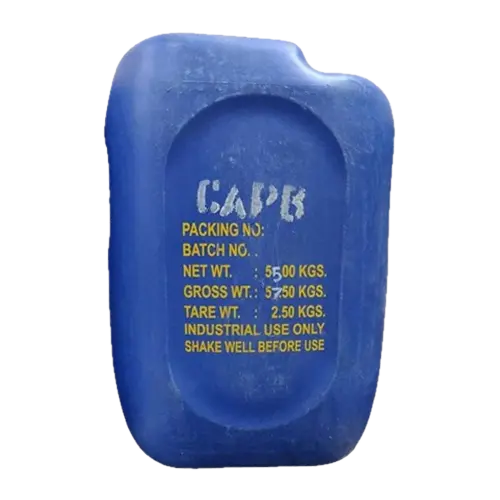
Because allergy concerns center on manufacturing residue, ask any supplier for the technical data sheet and for the specification on active matter and impurities. For a shampoo aimed at sensitive scalps, that purity information is worth more than a lower price per kilogram.
A worked dilution example
The raw material is 30% active, so the amount you weigh depends on the active level you want in the finished product. Divide the target active percentage by 0.30 to find the kilograms of solution per 100 kg batch.
| Target active CAPB | CAPB 30% per 100 kg batch | Batches from one 25 kg pack |
|---|---|---|
| 2% | 6.7 kg | 3.75 |
| 4% | 13.3 kg | 1.9 |
| 6% | 20.0 kg | 1.25 |
These are illustrations of the arithmetic, not recipes. For leave-on products, the safety assessment’s ceiling of 6% active is the figure to stay under.
Handling and storage
Mix gently. Vigorous stirring makes unwanted foam, so let the bubbles settle before bottling. Keep the raw material in sealed containers to avoid contamination and evaporation. Pair it with the right primary cleanser for your product, and test every finished batch on skin before you sell it.
Buy by purity, not just price: for a gentle shampoo, the impurity specification of the CAPB matters as much as its active percentage.
What to take from all this
Cocamidopropyl betaine is a foam booster, thickener and mildness agent that makes shampoo feel better and irritate less. The safety data supports its use at the levels found in shampoo, and rinsing keeps exposure low. The real side effects are scalp irritation and, for a minority, an allergy often tied to manufacturing impurities. A label check and a two-day patch test will catch most problems early.
If you make hair or body products and need cocamidopropyl betaine, you can send us an email and request a quotation for the pack size you need.