

Blog
Is Coco Betaine the Same as Cocamidopropyl Betaine?

The short answer to is coco betaine the same as cocamidopropyl betaine is no. They are two separate amphoteric surfactants, and both are built on coconut-derived fatty chains. Cocamidopropyl betaine (CAPB) has an extra amide group and a short propyl link in its structure, and coco betaine does not. That small change affects how each one is made, how it is labelled, and how skin sometimes reacts to it.
An amphoteric surfactant is a cleansing molecule that carries both a positive and a negative charge, depending on the pH of the product. That is why betaines sit alongside harsher cleansers like sodium laureth sulfate and soften them. You find them in shampoos, body washes, hand soaps and baby products. At Masiye Labs we supply raw detergent and cosmetic grade chemicals, including CAPB 30%.
This article shows you where the two ingredients differ, why the difference matters, and how cocamidopropyl betaine is used, including usage percentages and a worked batch example. It ends with a practical way to choose between them.
Why the difference between them matters
The difference matters because the two names are used loosely, and that leads to wrong purchases, wrong formulas and wrong assumptions about skin safety. A label that says "betaine" can mean three different things.
Three ingredients that share one word
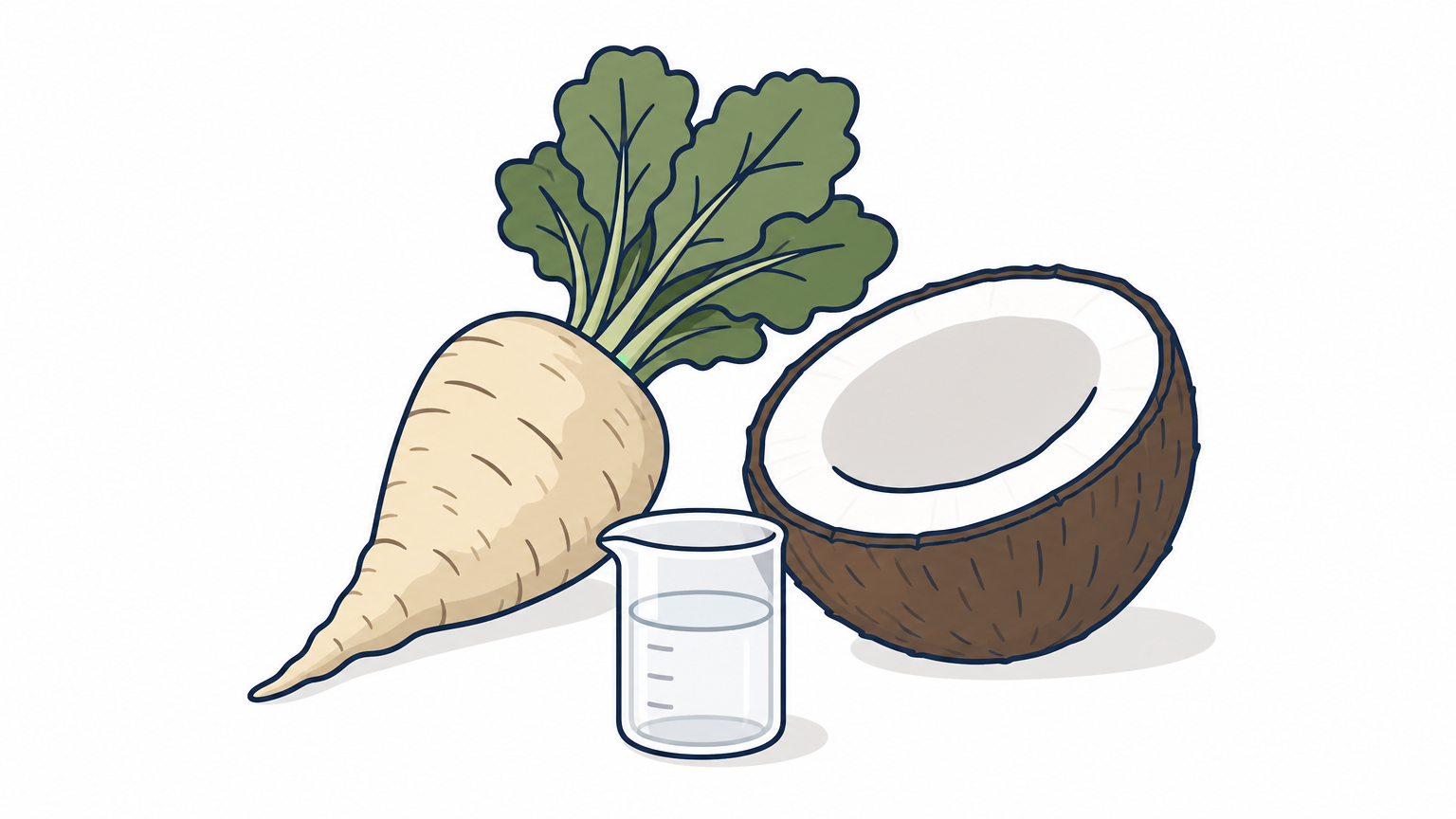
"Betaine" on its own means trimethylglycine, a small molecule usually extracted from sugar beets. It is a humectant that holds water, not a cleanser. Coco betaine and cocamidopropyl betaine are both surfactant betaines that clean and foam. You will see articles that describe coco betaine as beet-derived. That mixes it up with plain betaine. Coco betaine comes from coconut fatty chains, not beets.
| Name on the label | What it is | Main job |
|---|---|---|
| Betaine | Trimethylglycine, often from sugar beets | Humectant, skin conditioning |
| Coco-Betaine | Coconut alkyl dimethyl betaine | Co-surfactant, foam |
| Cocamidopropyl Betaine | Coconut amidopropyl dimethyl betaine | Co-surfactant, foam, thickening |
Only two of these three "betaines" actually clean, and they are not interchangeable.
What a mix-up costs you
If you formulate, swapping one for the other changes viscosity, foam and mildness in ways you will not notice until the batch is made. A recipe that thickens well with salt using CAPB may behave differently with coco betaine at the same dose. You would have to retest, not just substitute.
If you are a consumer, the risk is different. Someone who reacted to a shampoo may suspect CAPB, then buy a "natural" product listing coco betaine and assume it is safe. It might be, but the two molecules have different track records. A reaction to one is a reason to check the other, not to trust it blindly.
How coco betaine and CAPB differ in chemistry and skin safety
The two differ in structure, in the way they are made, and in how much we know about their effect on skin. CAPB is the better documented. Coco betaine is simpler but less studied.
Chemistry and origin
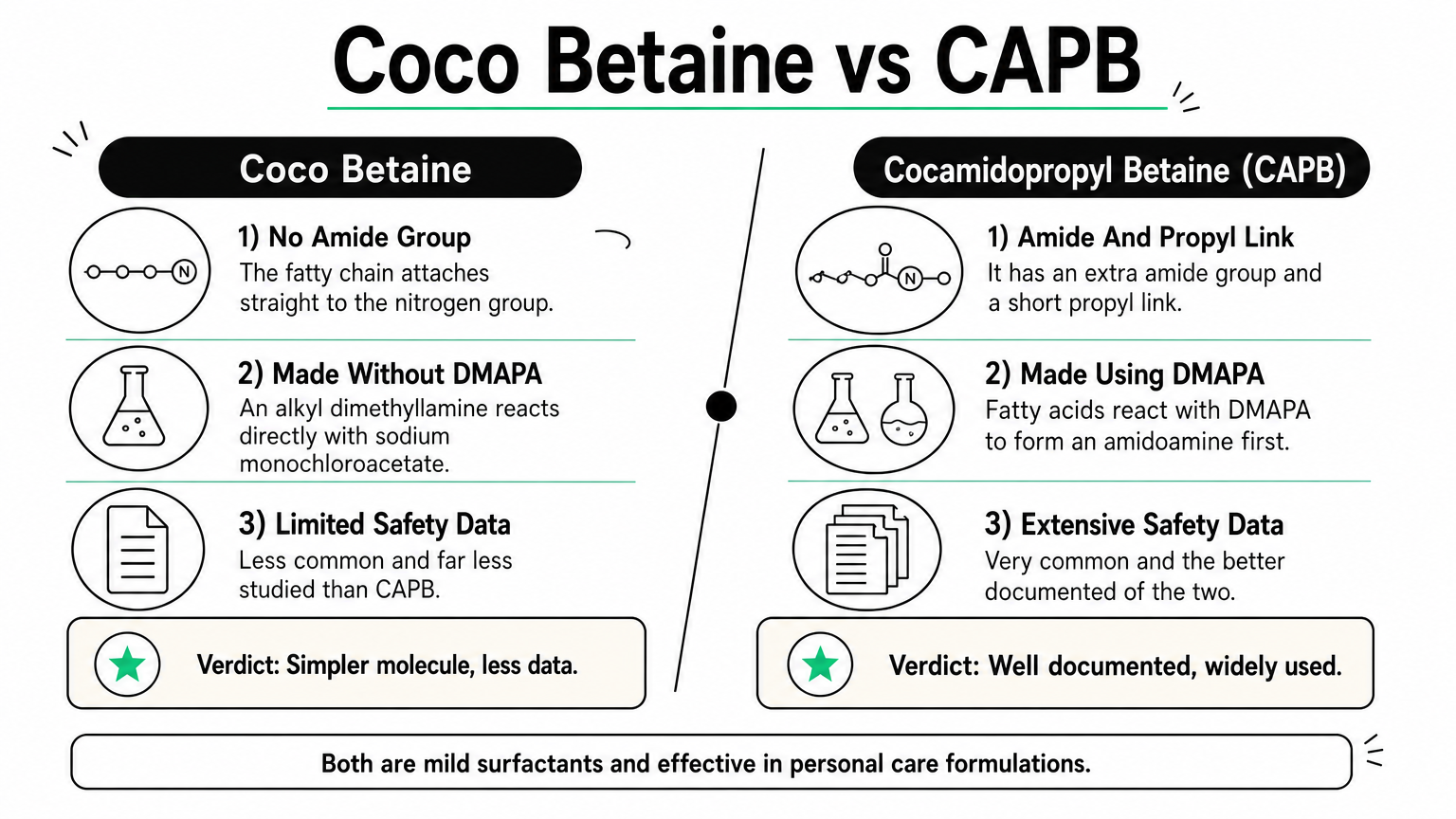
CAPB is made in two steps. Coconut fatty acids react with dimethylaminopropylamine (DMAPA) to form an amidoamine, which is then reacted with sodium monochloroacetate to form the betaine. Coco betaine skips the amide step. A coconut-derived alkyl dimethylamine reacts directly with sodium monochloroacetate. The result is a fatty chain attached straight to the nitrogen group.
| Feature | Coco betaine | Cocamidopropyl betaine |
|---|---|---|
| INCI name | Coco-Betaine | Cocamidopropyl Betaine |
| Fatty source | Coconut | Coconut |
| Amide group | No | Yes |
| Propyl linker | No | Yes |
| Made using DMAPA | No | Yes |
| How common | Less common | Very common |
| Safety data | Limited | Extensive |
Both are processed chemicals, so "natural" is a stretch for either. Coconut is the raw material, but each goes through chemical synthesis. Treat natural-origin claims as a statement about the starting material, not the finished molecule.
The amide group and DMAPA route are what separate CAPB from coco betaine in the lab and on the label.
Mildness and skin safety
Both are mild in rinse-off products, and claims about which is gentler conflict. Some writers say CAPB’s larger molecule makes it milder. Others say coco betaine is the gentler option. No decisive head-to-head evidence settles it. What matters more is the whole surfactant system, the pH and how long the product stays on skin.
For cocamidopropyl betaine on skin, the known issue is allergy. The American Contact Dermatitis Society named it Allergen of the Year in 2004. The reactions are mostly allergic contact dermatitis, an itchy rash where the product touched. Researchers believe impurities such as residual amidoamine and DMAPA from manufacturing drive most of it, not the betaine itself. Good manufacturing lowers the risk.
Coco betaine does not use DMAPA, so that particular impurity pathway does not apply. That is a theoretical advantage, not proof of safety, because far fewer studies exist. If you react to either one, stop using the product and check labels for both names. A persistent rash is a reason to see a doctor or dermatologist for patch testing.
How cocamidopropyl betaine is used in products
CAPB is used mainly as a co-surfactant in rinse-off cleansers, where it boosts foam, thickens the product and reduces the harshness of stronger detergents. It is rarely the only cleanser in a formula.
Where you will find it
The most common uses are shampoos, body washes, liquid hand soap, shower gels and baby wash. It also appears in facial cleansers, makeup removers, shaving cream, hair conditioners, toothpaste and some household cleaners. Its job changes slightly by product:
- Foam booster: it builds a thicker, more stable lather with anionic surfactants.
- Viscosity builder: with salt, it thickens a liquid so it does not run off your hand.
- Mildness aid: it lowers the irritation of harsher cleansers like sodium laureth sulfate.
- Conditioning: it gives a small antistatic effect in hair products.
In leave-on products the picture changes. Irritation is more likely if a surfactant stays on skin, so CAPB is mostly kept to products you wash off.
Usage percentage and a worked example
The usual commercial grade is a pale yellow liquid at about 30% active, and the usage level is stated for that product as supplied. Our CAPB 30% listing gives 5 to 30% as the typical range across formulations. As a co-surfactant next to SLES, formulators tend to sit nearer the lower end. A mild sensitive-skin or baby wash, where CAPB is a larger share of the cleanser, goes higher.
Here is the arithmetic for a shampoo batch:
- Batch size: 100 kg
- CAPB 30% at 8% of the batch: 8 kg of product
- Active matter: 8 kg × 0.30 = 2.4 kg, so 2.4% active in the finished shampoo
- A 25 kg container covers about three such batches (25 ÷ 8 = 3.1)
Always test on a small batch, because the right dose depends on the other surfactants, the salt and the pH.
Quote the dose as product at 30%, not as active matter, or your numbers will be off by a factor of more than three.
Handling tips
Keep it in sealed containers to prevent contamination and evaporation. When mixing, stir gently, because aggressive agitation creates foam that is hard to remove. Let bubbles settle before you bottle. These are small habits, but they save a batch.
How to choose between coco betaine and CAPB
Choose CAPB when you want a well-documented, widely available co-surfactant and thickener. Consider coco betaine when your brand or customer base specifically wants to avoid the amidoamine and DMAPA route, and you accept that there is less data.
Use this checklist before you decide:
- Product type: rinse-off cleanser, or leave-on? Prefer neither in leave-on without testing.
- Customer sensitivity: a baby or sensitive-skin line deserves a patch test with the finished formula, whichever betaine you use.
- Supply and documentation: can you get a consistent grade, a safety data sheet and batch information?
- Claims: if you market "natural", describe the coconut origin accurately, not the finished chemistry.
- Substitution: never swap one for the other at the same dose. Retest viscosity, foam and pH.
On our side, we stock CAPB 30% in 25 kg and 200 kg sizes, plus a separate 200 kg CAPB listing, in our raw detergent and cosmetic grade chemicals collection. Check the concentration on each product page before you work out dosing. If you need a different betaine, send us a quotation request and we will tell you what is available.
Choosing the right betaine for your formula
Coco betaine and cocamidopropyl betaine are related, not identical. Both are coconut-based amphoteric surfactants. CAPB carries an amide group and is made through DMAPA, while coco betaine is a simpler molecule that is less common and less studied. Neither is automatically gentler, so test the finished product.
If you are making shampoo, body wash or hand soap, CAPB remains the practical default. You can browse our cosmetic grade chemicals in the shop or ask for a quotation for the sizes you need.