

Blog
PPE Equipment in Laboratory: What It Is and How to Choose

PPE equipment in laboratory work is the clothing and gear that puts a physical barrier between you and a hazard. The minimum for anyone working with chemical, biological or mechanical hazards is a lab coat, eye protection, long pants and closed shoes. You then add gloves, a face shield, a respirator or hearing protection, depending on what the task can do to you. PPE does not remove a hazard. It limits the damage when other controls fail, which is why it is called the last line of defense.
This guide explains why personal protective equipment matters in a laboratory, what every worker and visitor should wear as a baseline, and how to match gear to specific hazards. You will also find a glove material table, notes on using and replacing each item, and a worked example of what a basic kit costs in rand.
Masiye Labs has supplied laboratory equipment, glassware and chemicals to South African laboratories since 2013, and safety wear is part of that range. Many labs buy the coat and goggles first and never do the hazard assessment that should decide the rest. This article gives you that missing logic.
Why PPE equipment in laboratory work matters
PPE matters because it is the layer that still protects you when ventilation, procedures and containment fail. A laboratory can put corrosive liquids, volatile solvents, pathogens, hot glass, cryogenic liquids, fine powders and loud equipment within one arm’s reach. One splash to the eye or one dropped flask can cause an injury that does not heal, so the gear on your body has to be right before the work starts.
PPE is the last line of defense
Safety professionals rank hazard controls in five steps, and PPE sits at the bottom. From most to least effective, they are:
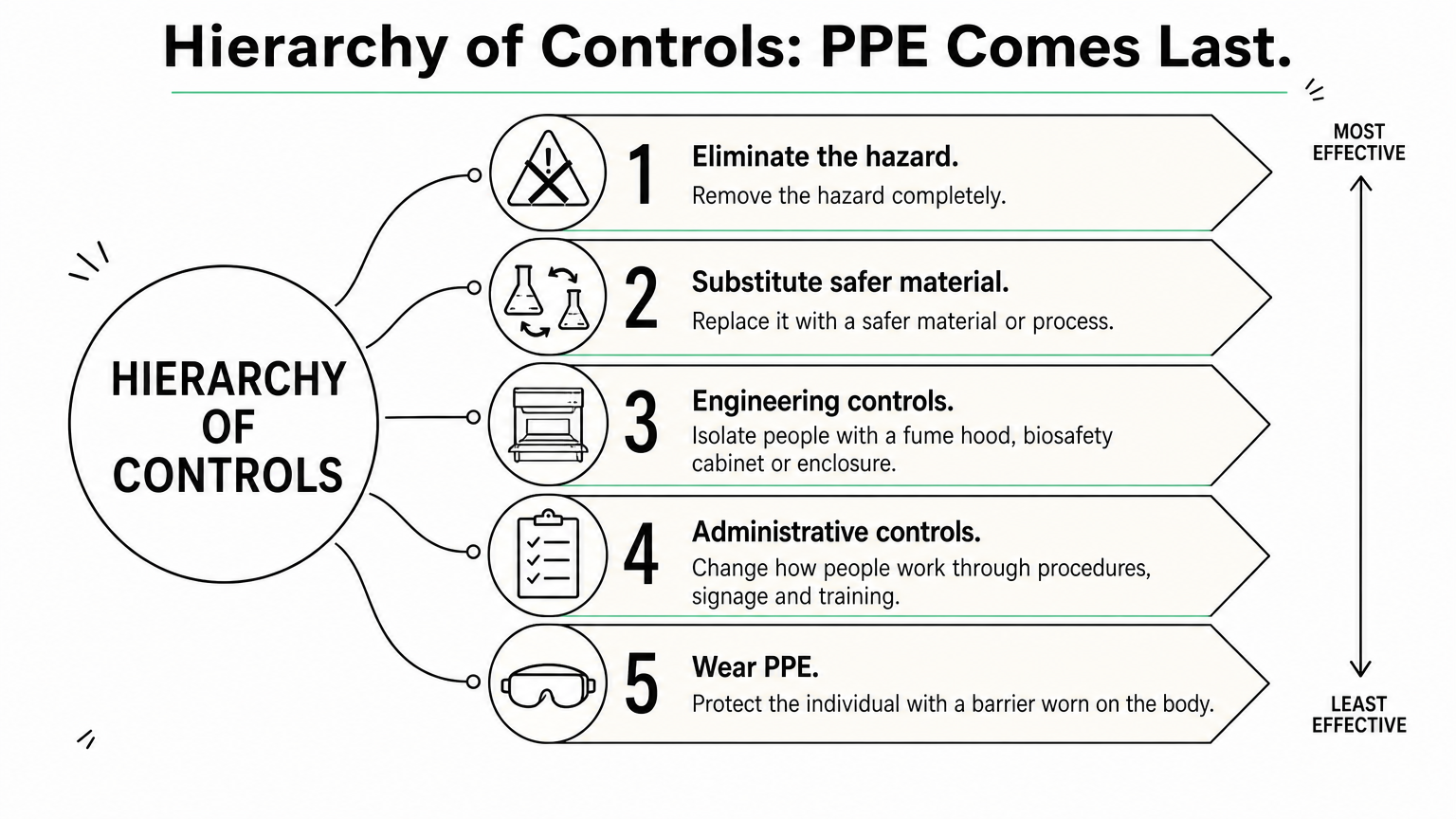
- Elimination: remove the hazard completely.
- Substitution: replace it with a safer material or process.
- Engineering controls: isolate people from the hazard with a fume hood, biosafety cabinet or enclosure.
- Administrative controls: change how people work, through procedures, signage and training.
- PPE: protect the individual with a barrier worn on the body.
That order tells you how to use PPE. First ask whether a hazard can be removed or swapped for a safer chemical, whether a hood or cabinet can contain it, and whether a changed procedure can cut exposure. PPE covers what is left. Relying on PPE alone is a warning sign, because a glove or coat only works if the person wears it correctly every time.
PPE is what protects you when every other control has already failed.
What PPE protects you from
PPE blocks the routes by which a hazard reaches your body: skin and eye contact, inhalation of dust, mist or vapor, and absorption through the skin. It also stops indirect exposure. A contaminated glove that touches your face, a door handle or a phone carries the hazard to places where it was never meant to go.
Good PPE also works in the other direction. A lab coat keeps your street clothes clean and stops you from carrying residue to the cafeteria or home. Gloves keep skin oils and contamination away from your samples. In that sense, protective equipment in the laboratory protects your results and your colleagues as well as you.
Your duties as employer and as worker
In South Africa, the Occupational Health and Safety Act 85 of 1993 puts the duty to provide a safe working environment on the employer. Employees must follow safety rules and use the protective equipment they are given. The regulations for hazardous chemical agents and for hazardous biological agents add requirements for risk assessment and exposure control. Check the current text with your safety officer or an occupational hygienist, because this article is general guidance and not legal advice.
In practice, the lab manager or supervisor sets the minimum PPE rules, makes sure the right equipment is on the shelf, and enforces its use. Workers must know what to wear for each task and refuse to start work when the gear is missing or damaged. Training and its records matter as much as the equipment itself, and the section on using and maintaining PPE covers both.
The minimum PPE every lab worker needs
The baseline for anyone working in a lab with chemical, biological, radiological or mechanical hazards is a lab coat, eye protection, long pants and closed-toe shoes. Gloves and other items are added according to the task. This baseline is the floor. A hazard assessment can raise it, but it should never lower it.
The four-item baseline
Each baseline item covers a specific failure. The table sets out what each one does and the rule that goes with it.
| Item | What it does | Rule of thumb |
|---|---|---|
| Lab coat | Shields skin and clothing from splashes and contamination | Fastened, sleeves down, removed before leaving the lab |
| Eye protection | Guards against impact, splashes and flying particles | Worn by everyone in the room whenever hazards are present |
| Long pants | Covers the legs against drips and broken glass | No shorts, skirts above the ankle or loose fabric |
| Closed-toe shoes | Protects feet from spills and dropped objects | No sandals, mules or mesh shoes |
| Gloves (task specific) | Protect hands from the material in use | Chosen by chemical and task, not by habit |
Gloves are the one item on that list that has to change with the work. A glove that suits one solvent can fail within minutes on another.
Rules for visitors, students and contractors
Visitors need protection too. Eye protection is the minimum for a "no touch" visit to a lab with chemical, biological, radiological or mechanical hazards. Where chemical, biological or radiological hazards could reach the visitor, provide a lab coat as well. Supervisors should apply the same dress rules to students, contractors and maintenance staff who enter the room.
Eye protection should stay on at all times where hazardous materials are handled or stored, even if you are not working with them at that moment. Someone else’s splash does not check who is wearing glasses. Excessively loose fabric and short garments belong outside the lab as well.
Anyone who walks into a working lab wears eye protection, whether they touch anything or not.
What does not count as PPE
Some common items look protective but are not. Ordinary prescription glasses are not safety glasses, because they lack side shields and an impact rating. A surgical or cloth mask is not a respirator, and it will not filter fine dust or mist in the way a rated respirator does. Fabric and leather gloves absorb and hold chemicals against the skin, so they are no use against chemical or biological hazards. Sandals and perforated shoes fail against spills and falling objects.
How to choose PPE for your lab hazards
Choose lab PPE by running a hazard assessment on each task. You identify the hazard, the way it can reach your body, and then pick equipment rated for exactly that. Guessing from a general rule is how labs end up with nitrile gloves on a solvent that dissolves them.
A step-by-step hazard assessment
Work through these steps for each task, including cleaning, waste handling and equipment maintenance:
- List the task in enough detail to see where hands, face and body will be.
- Name the hazards: chemical identity, concentration and volume, biological agents, heat, cold, sharp objects, radiation, light, noise.
- Identify the exposure route: skin, eyes, inhalation, injection or accidental ingestion.
- Ask whether a control can reduce the risk: a fume hood, smaller volumes, a safer substitute.
- Select PPE rated for what remains, using the safety data sheet and manufacturer data.
- Check fit and compatibility, because goggles that clash with a respirator seal will not get worn.
- Document the result and make sure everyone doing the task has read it.
The safety data sheet is your best first source. Section 8 covers exposure controls and personal protection, and it often names the glove or respirator type. If the sheet does not, use the glove manufacturer’s chemical resistance chart, and contact the manufacturer directly when your chemical is not listed. Different manufacturers use different formulations, so a chart for one brand does not transfer to another.
Factors that drive the selection
Several factors decide whether a given item is good enough. The same chemical at 5% and at 98% can need different gloves. The same glove can last an hour or two minutes depending on how long contact lasts.
- The identity, concentration and quantity of the material
- How the material can reach you: splash, vapor, dust, contact, needle
- The PPE material’s permeation and degradation behavior against that chemical
- How long the contact or exposure is likely to last
- Fit and comfort, since PPE that irritates or restricts gets removed
Go beyond the minimum when quantities are large, when you handle concentrated corrosives, or when you do not yet know how a reaction behaves. Standards bodies treat the baseline as the lowest acceptable level, not the target.
A hazard-to-PPE matrix
The matrix below gives typical starting points. Your assessment and the safety data sheet always overrule it.
| Hazard | Typical PPE | Watch out for |
|---|---|---|
| Small liquid splashes | Splash goggles, nitrile gloves, lab coat | Safety glasses leave gaps at the sides and top |
| Pouring large volumes or corrosives | Goggles plus face shield, chemical-resistant apron, gloves rated for the chemical | A face shield is never worn alone |
| Fine powders and dust | FFP2 respirator, goggles, gloves, coat | Use an enclosure for weighing where possible |
| Volatile solvents and vapors | Fume hood first; a correctly selected cartridge respirator only if the hood is not enough | Dust masks do not stop vapors |
| Biological agents | Coat or gown, nitrile gloves, eye protection, respirator as risk assessment dictates | Double gloving for highly infectious material |
| Hot glassware and ovens | Heat-resistant gloves, coat, closed shoes | Check the temperature rating of the glove |
| Cryogens and dry ice | Cryogenic gloves, goggles plus face shield, coat | Gloves must come off fast if liquid gets in |
| Broken glass and sharps | Cut-resistant gloves, closed shoes | Dispose of sharps in a sharps container, never in a bin |
| Noise above 85 dBA | Earplugs or earmuffs | Choose by the measured noise level |
Pick PPE for the specific chemical and task in front of you, not for the lab in general.
Eye, face and hand protection in detail
Eyes and hands are the body parts most exposed to splashes and spills, so they involve the most selection decisions. The short version is safety glasses for impact, goggles for splash and vapor, a face shield on top for large volumes, and a glove material matched to the chemical.
Safety glasses, goggles and face shields
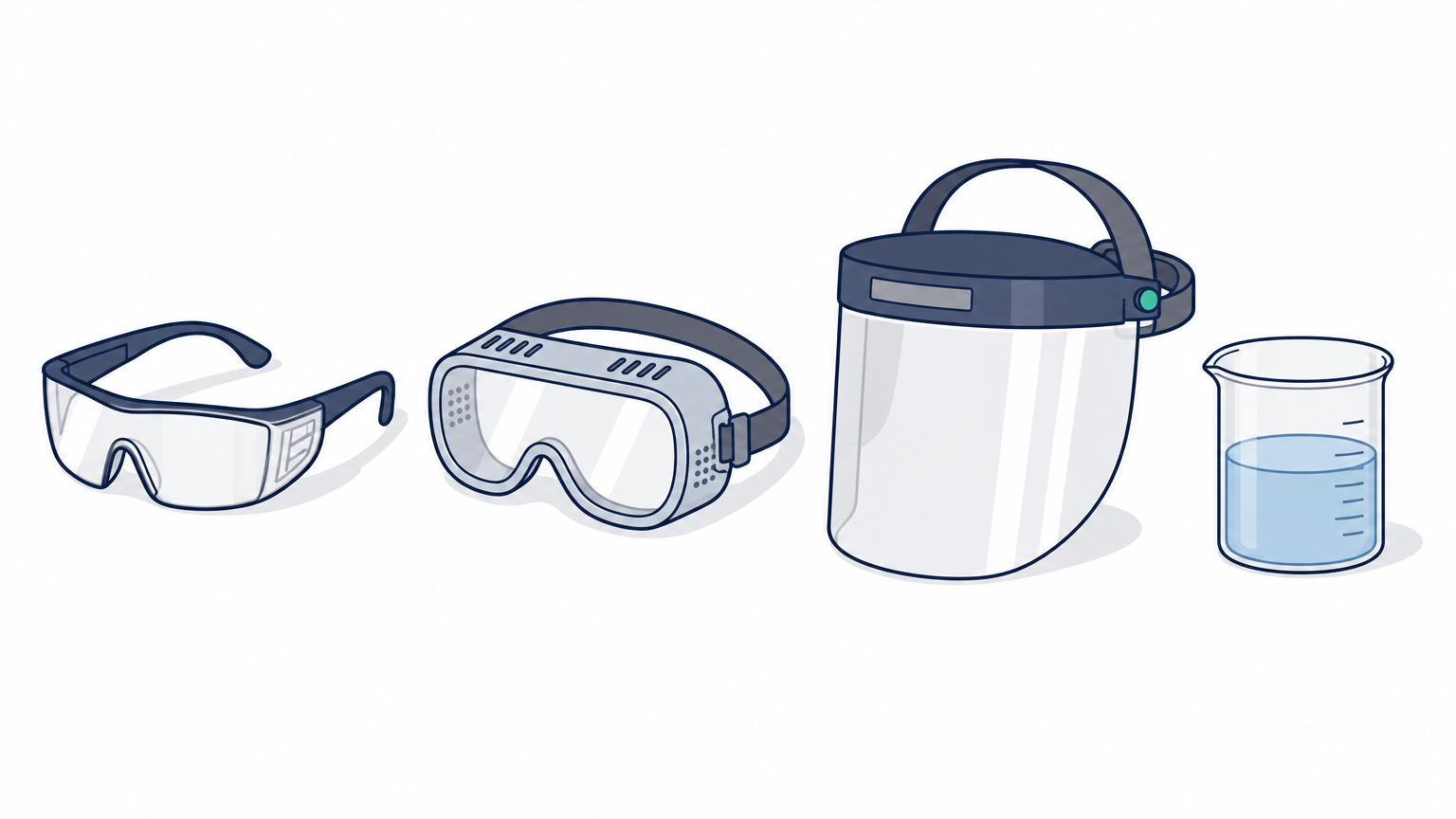
These three items are often confused. They protect against different things, as the table shows.
| Item | Protects against | Not enough for |
|---|---|---|
| Safety glasses with side shields | Impact and flying particles | Chemical splash, vapors, pouring and mixing |
| Splash goggles | Liquid splashes, chemical vapors, bulk transfers | Full-face exposure on their own |
| Face shield | Splatter across the whole face, sparks, flying particles | Use as the only eye protection |
Look for a "Z87" marking on the frame, usually on the temple, which signals ANSI Z87.1 compliance. EN 166 is the equivalent European marking. Workers who need corrective lenses should use prescription safety eyewear or goggles that fit over their glasses. Wear a face shield over glasses or goggles when you dispense cryogens, prepare a corrosive bath, handle molten material or pour large volumes. OSHA’s eye and face protection guidance is a solid reference for selection.
Choosing glove material
Disposable nitrile gloves are the usual minimum in a lab, but they only protect against incidental contact. If a chemical touches the glove, remove it immediately, wash your hands, and put on a fresh pair. For anything beyond a splash, the glove has to be matched to the chemical. The table summarizes common materials.
| Material | Resists | Notes |
|---|---|---|
| Nitrile | Alcohols, caustics, organic acids, some ketones | Standard disposable glove; acceptable alternative to latex for biological work |
| Neoprene | Mineral acids, organic acids, caustics, alcohols, petroleum solvents | A common reusable choice for acid work |
| PVC | Mineral acids, caustics, organic acids, alcohols | Reusable; check the thickness rating |
| PVA | Chlorinated solvents, petroleum solvents, aromatics | Dissolves in water, so keep it away from aqueous solutions |
| Laminate (Silver Shield type) | Highly toxic chemicals and those absorbed through skin, across a wide range | Poor dexterity, often worn under nitrile; not recommended for chloroform |
| Natural rubber latex | Ketones, alcohols, caustics, organic acids | Weak against many chemicals and a common allergy trigger |
Avoid latex for chemical work. It protects poorly against many chemicals and can cause allergic reactions in some people. Non-chemical hazards need their own gloves: insulated gloves for heat, rated cryogenic gloves for liquid nitrogen and dry ice, and cut-resistant gloves for sharp objects.
No glove material resists every chemical, so match the glove to the chemical, not to habit.
Double gloving and when to change gloves
Double gloving means wearing a second pair over the first. If the outer glove tears or degrades, the inner glove still protects you while you strip both and start again. Use it for hazardous biological agents, highly toxic chemicals or when the assessment says one layer is too thin. Two different materials can be worn together when a mixture contains chemicals that attack different glove types.
Check outer gloves often for pinholes, color changes or a change in texture. If the outer glove is contaminated, remove it and put on a new one. If the inner glove shows contamination, remove both pairs, wash your hands and rethink the glove choice. Do not wear gloves outside the lab, including in corridors and lifts, because that spreads whatever is on them.
Body, foot, respiratory and hearing protection
Beyond eyes and hands, a lab needs a coat suited to the chemicals present, proper footwear, respiratory protection when air quality is a risk, and hearing protection near loud equipment. These items are chosen by the same hazard logic as gloves, and each has its own common mistake.
Lab coats and protective clothing
A lab coat is a barrier for skin and clothing against splashes and contamination, and it can be pulled off quickly in an emergency. Choose the fabric for the hazard. General cotton or blended coats suit light work. Acid-resistant coats suit corrosives. Flame-resistant coats suit flammable liquids and pyrophoric materials. Disposable gowns, chemical-resistant aprons and sleeves go on top when splash risk is high.
Wear the coat fastened, with sleeves down and a size that does not drag or catch on equipment. Keep it inside the lab and out of cafeterias and offices. Never take a contaminated coat home to wash with household laundry. Use a laundering arrangement agreed with your safety officer, or discard it if it is disposable or heavily contaminated.
Footwear
Closed-toe, covered shoes are the baseline. Leather or chemical-resistant rubber boots suit areas where spills are likely. Sandals, mules and perforated shoes let liquids reach the skin and give no protection against dropped objects. Steel-toed or composite-toed shoes are for work with heavy equipment or materials, and composite toes are lighter and non-metallic. Shoe covers can keep contamination from leaving a restricted area.
Respirators and masks
A respirator is for inhalation hazards that engineering controls cannot handle adequately. Use a fume hood, enclosure or local exhaust first, and treat the respirator as the backup. A filtering facepiece such as an FFP2 filters airborne particles, and under the EN 149 standard it must filter at least 94% of test particles. It does not protect against gases or vapors. For those you need a half-face or full-face respirator with the right cartridge, selected by an occupational hygienist or safety officer.
A tight-fitting respirator also depends on a good seal. Facial hair under the sealing edge breaks it. Fit testing, training and, where regulations require it, a medical evaluation should happen before first use. Where a lab uses respirators routinely, it should run a formal respiratory protection program rather than leave the choice to individuals.
A respirator only works if it fits your face and suits the contaminant, so fit testing is not optional.
Hearing protection
Grinders, sonicators, compressors, vacuum pumps and animal housing areas can produce hazardous noise. A common action level is an 8-hour average of 85 dBA, which triggers hearing conservation measures under the US OSHA noise standard. Noise-induced hearing loss is preventable but permanent once it happens.
Earplugs and earmuffs give different levels of attenuation, so select them from a noise measurement, not from guesswork. Try to cut the noise at its source first, with enclosures or quieter machinery. Then supply protection that fits comfortably, because hearing protection that hurts stays in a pocket.
How to use, maintain and replace lab PPE
Good PPE fails when it is worn wrongly, stored badly or kept past its life. The fix is training, a fixed order for putting on and taking off, and simple inspection habits. These matter as much as the purchase.
Training that sticks
Everyone who wears PPE should be trained before they start work. Training should cover when PPE is needed, which items apply, how to put them on, adjust and remove them, their limits, and how to clean, store and dispose of them. The person doing the task should show they understand it before working alone. Repeat the training when tasks or equipment change, and refresh it at regular intervals.
Write down who was trained, on what and when. Those records protect the lab in an audit or incident review. Put the PPE required for each task into the written procedure itself, so the instruction is in front of the person doing the work.
Putting on and taking off in the right order
Order matters because the outside of used PPE is contaminated. A workable sequence for most labs looks like this:
- Putting on: lab coat, respirator if needed, eye protection, gloves last, with cuffs pulled over the coat sleeves.
- Taking off: gloves first, then the coat, folding the contaminated side inward, then eye protection and the respirator.
- Finally: wash your hands with soap and water before leaving the lab.
To remove gloves safely, grasp the cuff of one glove with the other gloved hand and peel it off. Hold the removed glove in the remaining gloved hand, slide a clean finger under the cuff of the second glove, and peel it off over the first so both end up enclosed. If you must carry something while gloved, remove one glove and use your bare hand for door handles and locks.
Inspection, storage and replacement
Inspect PPE every time you use it. Discard disposable gloves after each use, and never reuse them. Keep reusable PPE in a clean, accessible place away from contaminated areas, and replace anything damaged or expired. The table gives a practical routine.
| Item | Check before use | Replace when |
|---|---|---|
| Gloves | Holes, cracks, discoloration, stickiness | After each use (disposable) or on contact with the chemical or any degradation |
| Goggles and glasses | Scratches, cracked lens, stretched strap | Lens is scratched or frame is cracked |
| Face shield | Cracks, crazing, working headband | Visor is cracked or cloudy |
| Lab coat | Stains, holes, missing buttons | Soaked through, damaged, or contaminated beyond laundering |
| Disposable FFP2 respirator | Straps, seal, soiling | Damaged, wet, soiled or hard to breathe through |
| Earplugs and earmuffs | Cushion condition, hygiene | Damaged or no longer a good fit |
Inspect PPE before every use, because damaged gear gives protection that is only imaginary.
Kitting out a lab: a worked example with rand prices
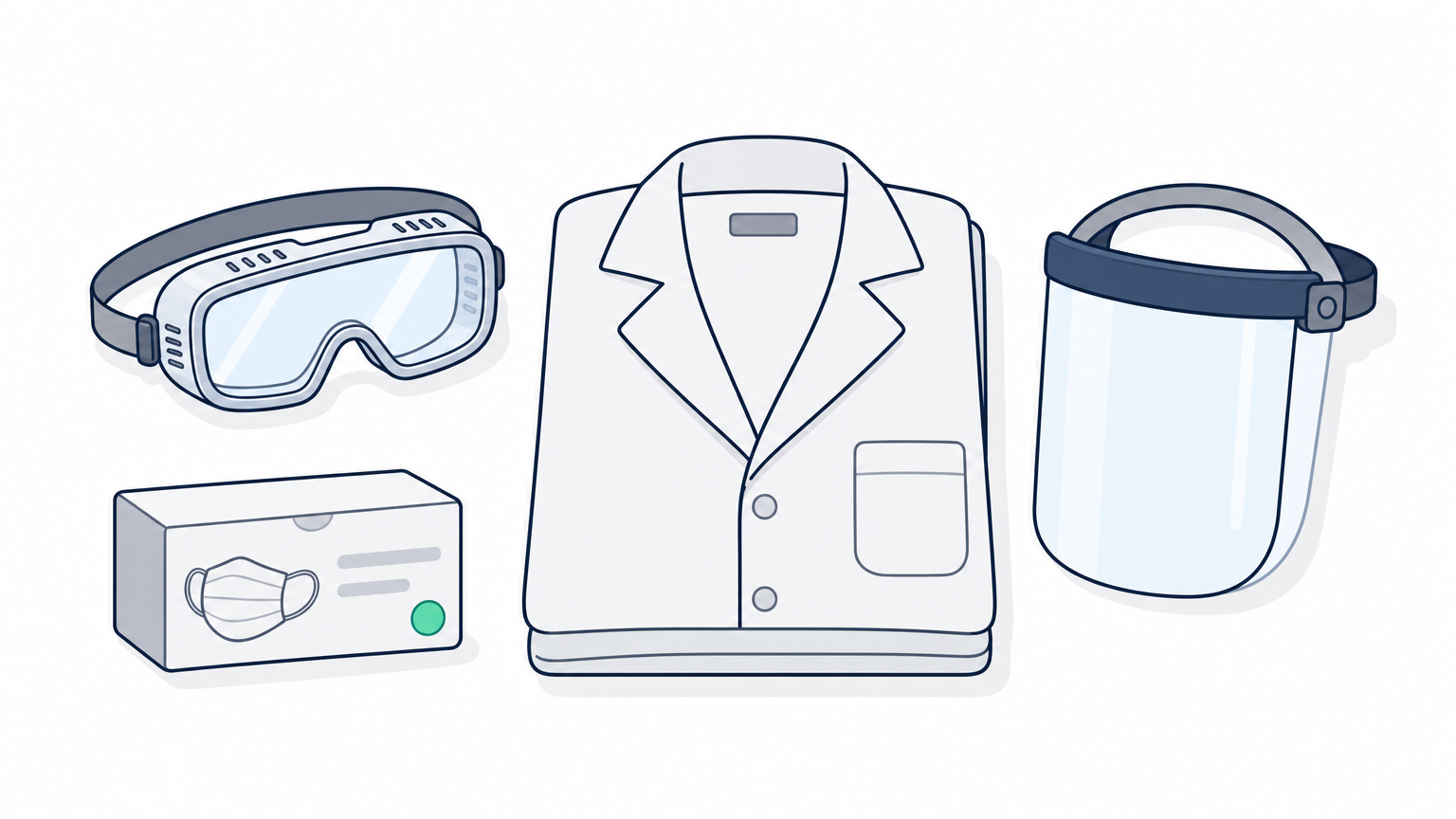
A one-person kit of safety goggles, an acid-resistant lab coat and a face shield comes to R675 at the listed Masiye Labs prices, which include VAT. Gloves are left out because they depend on your chemicals, as the glove section explains. Check the shop for current prices before you budget.
One analyst’s starter kit
The table builds the example from the Safety Wear range. The respirator is optional and covers powder handling.
| Item | Listed price |
|---|---|
| Safety goggles (polycarbonate lens, anti-mist coating, vented) | R45 |
| Laboratory coat, acid resistant | R435 |
| Face shield | R195 |
| Kit total | R675 |
| FFP2 dust mask respirator, box of 20 (about R19 per mask) | R380 |
| Kit total with FFP2 box | R1,055 |
The goggles are vented to reduce misting. Vents can let vapor or liquid in, depending on their design, so for work with corrosive splashes confirm the splash rating with the supplier before relying on them. The FFP2 masks are for dust and mist, not vapors, so they do not replace a fume hood or a cartridge respirator.
Scaling to a teaching lab
Take a teaching lab with 12 students and 2 demonstrators. Goggles for 12 students come to R540 (12 × R45). Acid-resistant coats at R435 each come to R5,220. Two face shields for demonstrations add R390 (2 × R195). The total is R6,150, before gloves and any respirators.
Lab coats come in sizes 30 to 44 in the Masiye Labs range, so measure students before you order. If you need approval before you buy, the Add to Quote tool lets you build a quotation, download it or email it to yourself, and buy later.
Price a kit per person first, then multiply by headcount and add the hazard-specific extras.
Match the PPE to the hazard
PPE equipment in laboratory work comes down to one habit: assess the hazard, then match the gear to it. Start from the baseline of coat, eye protection, long pants and closed shoes. Add gloves by chemical, a face shield for large volumes, a respirator when air quality demands it, and hearing protection near loud equipment. Then train people, inspect the gear and replace it before it fails.
If you are stocking a new lab or refreshing an old kit, you can shop safety wear and laboratory supplies online with prices in rand including VAT. For items outside the standard range, you can email the Masiye Labs team to request a quotation.