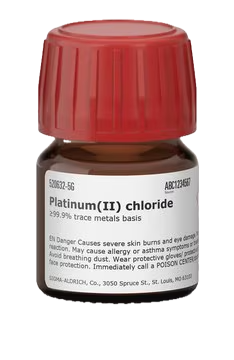
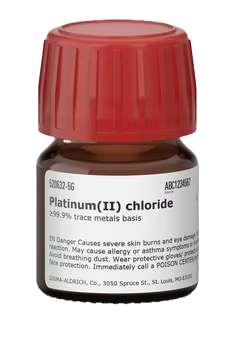
Platinum Chloride 1g
R12,456.00
Platinum Chloride 1g
A 1g quantity of platinum chloride (usually Pt(IV) or Pt(II)) is used in professional labs for catalysis (organic synthesis, fuel cells), as a precursor for nanomaterial synthesis (Pt nanoparticles, photocatalysts), in surface modification, semiconductor production, and for preparing other platinum compounds, serving as a source of platinum for high-tech applications, not for consumer or medical use.
Key Applications:
Platinum Chloride 1g
Catalysis: Acts as a catalyst in various organic reactions, including making anti-cancer drugs (e.g., cisplatin precursors) and for fuel cell electrocatalysts.
Nanomaterials: A starting material for creating platinum nanoparticles for applications like photocatalytic hydrogen production.
Materials Science: Used in the production of semiconductors (epitaxy) and for surface treatment of materials like titania to enhance photocatalytic activity.
Electroplating & Electronics: Involved in platinum plating processes and creating conductive electrodes.
Research: A valuable reagent for synthesizing complex platinum complexes and studying chemical reactions.
Platinum Chloride 1g
Form Comparison Feature Platinum(II) Chloride (\(PtCl_{2}\))Platinum(IV) Chloride (\(PtCl_{4}\))
AppearanceDark brown solidBrown to red/black crystals
SolubilityInsoluble in waterHighly soluble in water and polar solvents
Main UseCatalyst for bond addition and cyclizationSurface modification and photocatalysis
Note: These chemicals are strictly for professional research, manufacturing, and industrial use.
They are generally not available for medical or personal consumer use. C
Related products