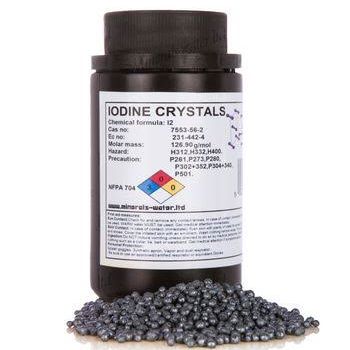
Iodine Crystals 500g
R2,950.00

Iodine crystals 500g
| Weight | 0.600 kg |
|---|---|
| Dimensions | 15 × 15 × 15 cm |
Iodine Crystals 500g
In labs, iodine crystals are vital for organic synthesis (iodination), analytical chemistry (starch indicator, titrations), microscopy staining (starch, cells), and producing pharmaceuticals, dyes, and disinfectants like iodoform and iodine tinctures, often used for demonstration and as reagents in various chemical reactions.
Key Lab Uses
Analytical Chemistry: Used as a starch indicator (turns blue-black) and in iodometric titrations to determine concentrations of substances.
Organic Synthesis: A reagent for introducing iodine into organic molecules (iodination), forming compounds like iodoform (a strong antiseptic) and other medicinals.
Microscopy & Biology: Stains glycogen, protozoan cysts, and nuclei, making them visible in wet mounts and histology.
Demonstrations: Excellent for showing sublimation (solid to gas) and fundamental halogen chemistry.
Catalysis: Acts as a catalyst in certain chemical processes, enhancing reaction rates.
Disinfectant Research: Used in developing new antimicrobial agents and solutions, including traditional iodine tinctures.
Related Applications
Water Purification: Ingredient in tablets to kill microorganisms.
Pharmaceuticals: Precursor for iodine-containing drugs.
Dyes & Inks: Used in manufacturing certain dyes and printing inks.
Iodine Crystals 500g
Iodine crystals 500g
The laboratory grade is used for research analytical purposes
Iodine is also used in medical treatment as tincture and iodioform, it is employed in the preparation of certain drugs and in the manufacture of some printing inks and dyes.
Silver iodine is used in photography. Iodine is added to almost all the table salt and is used as a supplement to animal feed.
It is also an ingredient of water purification tablets that are used for drinking water preparation.
For many of these uses iodine is turned into iodides.
| Atomic number | 53 |
| Atomic mass | 126.9045 g.mol -1 |
| Electronegativity according to Pauling | 2.5 |
| Density | 4.93 g.cm-3 at 20°C |
| Melting point | 114 °C |
| Boiling point | 184 °C |
| Vanderwaals radius | 0.177 nm |
| Ionic radius | 0.216 nm (-1) ; 0.05 nm (+7) |
| Isotopes | 15 |
| Electronic shell | [ Kr ] 4d10 5s25p5 |
| Energy of first ionisation | 1008.7 kJ.mol -1 |
| Standard potential | + 0.58 V ( I2/ I– ) |
| Discovered | Bernard Courtois in 1811 |
Iodine Crystals 500g
Related products