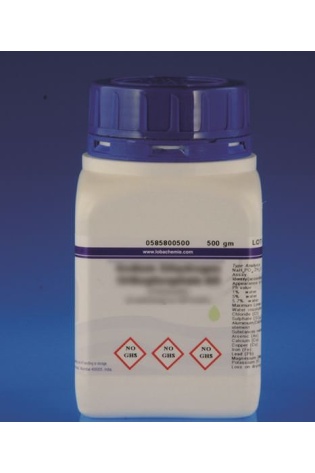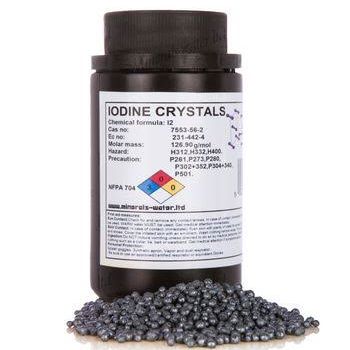
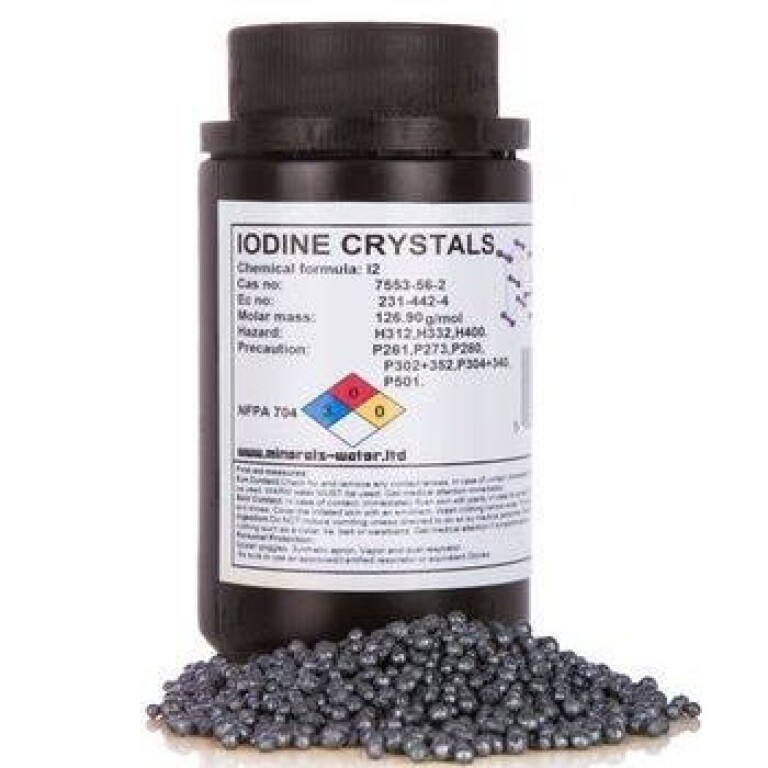
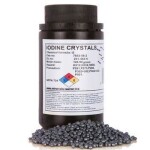
Iodine Crystals 1kg
R5,480.00

Iodine Crystals 1kg
| Weight | 1.1 kg |
|---|---|
| Dimensions | 20 × 15 × 15 cm |
Iodine Crystals 1kg
In labs, iodine crystals (I₂) are crucial for analytical chemistry (starch indicator, iodometric titrations), organic synthesis (iodination), microscopy (staining), demonstrations (sublimation), and creating antiseptics like iodine tincture or iodoform, also used for water purification research and pharmaceuticals.
They serve as reagents for detecting substances, in making dyes, inks, and photographic chemicals, and as catalysts in various reactions.
Iodine Crystals 1kg
Key Lab Uses:
Analytical Chemistry:
Starch Indicator: The blue-black color change with starch is fundamental for titrations and testing for starch.
Iodometric Titrations: Used as a reagent to determine concentrations of reducing agents.
Organic Synthesis:
Iodination Reactions: Introduces iodine into organic molecules.
Iodoform Production: A precursor to the antiseptic iodoform (CHI₃).
Biological & Medical Applications:
Staining: In microscopy for revealing cell structures or pathogens, like protozoan cysts in parasitology.
Antiseptics: Used in research and production of iodine-based disinfectants and tinctures.
Chemical Demonstrations:
Sublimation: Visually demonstrates iodine’s ability to turn directly from solid to gas and back.
Research & Development:
Catalyst: Speeds up various chemical reactions.
Tracer: In chemical and biological studies.
Pharmaceuticals: Intermediate in creating iodine-containing drugs.
Related Applications:
Water Purification: Active ingredient in some purification tablets.
Electronics: Component in manufacturing LCD polarizing filters.
Photography: Used in photographic emulsions and films.
Iodine Crystals 1kg
Iodine Crystals 1kg
The laboratory grade is used for research analytical purposes
Iodine is also used in medical treatment as tincture and iodioform, it is employed in the preparation of certain drugs and in the manufacture of some printing inks and dyes.
Silver iodine is used in photography. Iodine is added to almost all the table salt and is used as a supplement to animal feed.
It is also an ingredient of water purification tablets that are used for drinking water preparation.
For many of these uses iodine is turned into iodides.
| Atomic number | 53 |
| Atomic mass | 126.9045 g.mol -1 |
| Electronegativity according to Pauling | 2.5 |
| Density | 4.93 g.cm-3 at 20°C |
| Melting point | 114 °C |
| Boiling point | 184 °C |
| Vanderwaals radius | 0.177 nm |
| Ionic radius | 0.216 nm (-1) ; 0.05 nm (+7) |
| Isotopes | 15 |
| Electronic shell | [ Kr ] 4d10 5s25p5 |
| Energy of first ionisation | 1008.7 kJ.mol -1 |
| Standard potential | + 0.58 V ( I2/ I– ) |
| Discovered | Bernard Courtois in 1811 |
Related products